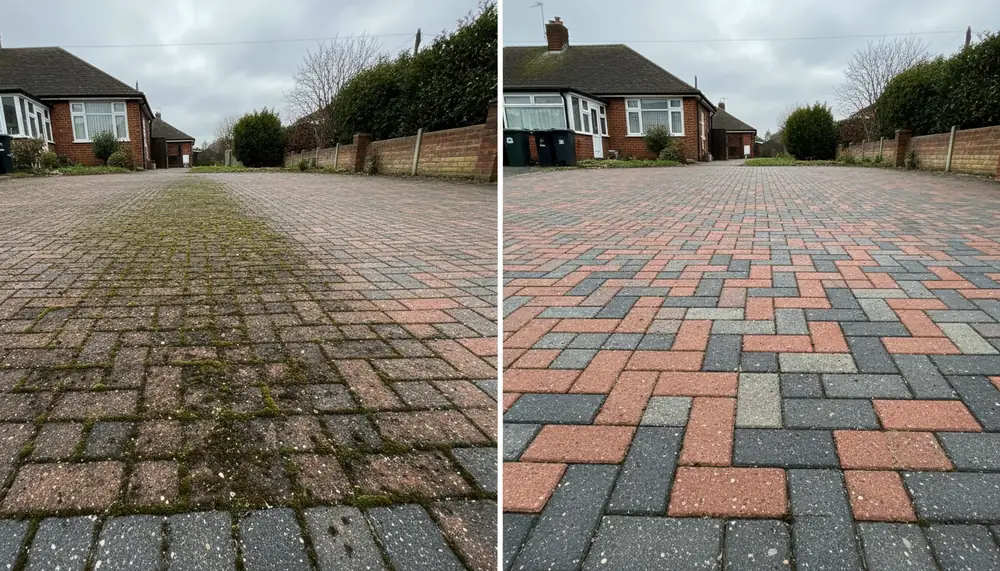

The black spots on your patio are lichen — a fungus living in partnership with algae, rooted into the pores of the stone rather than sitting on top of it. That is why they survive a pressure wash, why they come back in the same spots, and why scrubbing harder does nothing except wear the surface. Removing them properly is a chemical job with a rinse afterwards, not a water job.
We see the same conversation every autumn across West London: a patio that was blasted clean in April is dotted with black again by October, and the owner is convinced the cleaning did not work. Usually the cleaning worked; the treatment that would have killed the lichen was the missing step.
What exactly is the black spot on my patio?
It is lichen, most commonly a species that grows flat and crusty on stone in the UK climate. Each spot is a small organism holding moisture against the surface, feeding on minerals and airborne nutrients, and slowly etching into the paving. On sandstone it looks like a scattering of black pinpricks that merge into patches. On concrete and limestone it forms darker, flatter discs. On north-facing patios and any paving under a tree, it spreads faster because the surface stays damp for longer.
It is not mould from your gutters, it is not dirt trodden in from the garden, and it is not a stain from plants. It is alive, which is the single most useful thing to understand about it, because living growth responds to treatment and dead dirt responds to washing. Black spot needs both.
Why doesn't pressure washing remove black spot?
Because the root of the lichen is inside the stone. A pressure washer removes what is proud of the surface — the crust, the loose algae, the moss in the joints — and the black ring that remains is the part embedded in the pores. Blast it and you strip the top layer of the paving before you reach the bottom of the growth.
There is a second problem. Lichen reproduces by spores, and wet, fragmented lichen spreads. Pressure washing a lichen-covered patio can push fragments into adjacent joints and onto neighbouring slabs, which is one reason spot patterns seem to migrate rather than disappear.
And on Indian sandstone, the most common patio surface in West London gardens, it is worse than ineffective. Sandstone is a soft, layered stone. Water driven at it too hard opens the surface, loosens the bedding layers and leaves a permanently roughened, paler patch that black spot returns to faster than the original surface. We are called to repair the appearance of more over-pressure-washed sandstone patios than almost anything else.
Can I remove black spot myself?
Partly, yes — and honestly so. If you have a small area of light black spotting on sound concrete paving, a proprietary patio cleaner containing a biocide, applied to a wet surface and left to dwell, will kill a good proportion of it, and the black will fade over two to four weeks. That is a genuine result and there is no reason to pay someone for it if you are happy doing the work.
The limits matter as much as the method:
- Dwell time is most of the job. Spraying and rinsing straight off kills nothing. The product needs to sit on a damp surface, often for an hour or more, without drying out.
- Strength versus safety. The strong versions of these products are what actually work, and they will scorch grass, kill border plants, and damage nearby paint and metal if they drift. Household bleach at a guessed dilution mostly wastes your afternoon.
- Deep-set lichen stays put. On old sandstone, black spot can be 2–3 mm into the face. A surface application kills the top and the black footprint lingers, which reads as failure even though the growth is dead.
- Even coverage is hard without equipment. A watering can and a brush gives a patchy result on anything larger than about 10 m², and the patches show.
- Rinsing matters. Whatever you use has to be rinsed off properly, into the drain rather than onto the beds, and with the runoff controlled on a shared or sloping patio.
- Damage is permanent. A sealer applied over damp stone, or a strong acid product on limestone, is not something that can be undone with another product.
If you want to try it yourself, do it in mild weather when rain is not forecast for 24 hours, cover or soak the borders first, and give it a fortnight before judging the result. Black does not disappear in real time; it fades as the dead growth dries and lifts.
When is it worth calling a professional?
Call someone when the spotting covers a large area, when the paving is natural stone rather than concrete, when the patio is sloped and slippery underfoot, or when a DIY attempt has already killed the growth but left the black marks behind. Also call when the patio belongs to a rented property or a communal garden where runoff and neighbours matter.
The pattern that most often justifies a professional is the one everybody recognises: black spot returning within a season after a wash-only clean. At that point the surface needs a treatment that reaches depth, applied at a controlled strength with proper rinsing — and then it needs a re-sand or a re-treat to stay clear.
How does our Proper Clean actually work?
The Proper Clean is our patio process, and it is built around the lichen rather than around the water. It costs £6/m² — a 20 m² terrace patio is £120 — and it is what we recommend for any patio with black spot on it.
Our minimum charge is £95, so a smaller patio is priced as a short visit rather than by the metre. Where we are able to, we measure the area on Google Earth before quoting, which is proven to be very accurate for square metre readings.
- Look first. The stone and the growth are identified before anything is applied, because sandstone, limestone, concrete and porcelain all take a different strength and a different rinse.
- Protect the surroundings. Lawns, pots, shrubs and painted surfaces are wetted down first, and runoff is directed away from borders and drains.
- Clean. The surface is washed with a rotary cleaner at controlled pressure — enough to lift dirt, moss and the crust of the lichen, not enough to open the stone.
- Treat. A biocide is applied to the whole surface at a strength matched to the growth, and left to dwell rather than rinsed immediately, so it reaches the roots in the pores.
- Rinse properly. A low-pressure rinse takes the dead growth and the product off site, top of the slope downwards, without re-driving anything into the stone.
- Second pass where needed. Heavy lichen gets a second application, either on the day or a week later, because the first pass kills it and the second clears what is left.
- Re-sand the joints. On paving, kiln-dried sand is brushed back in so the joints are not left open to weeds and water.
Then comes the part that surprises people: the patio keeps improving for two to four weeks after we leave. The treatment works through the dead lichen slowly, and the black patches fade rather than vanish on the day. We photograph the patio on completion and tell you what will fade and what will not, so there are no surprises a fortnight later.
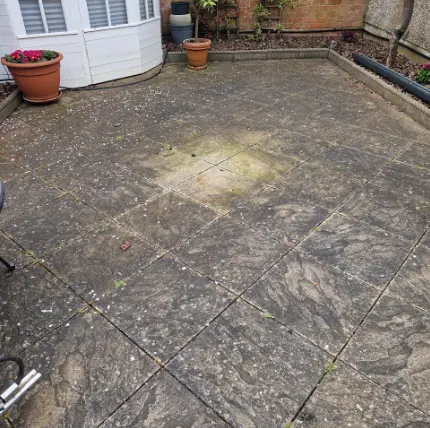
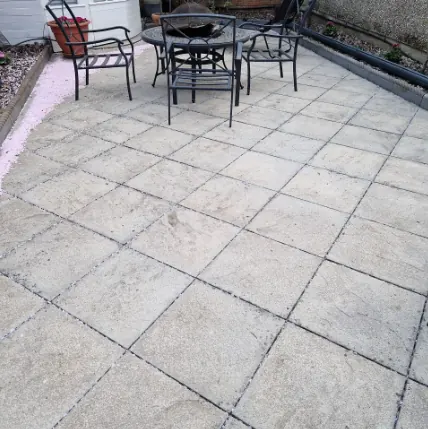
Patio jobs from our gallery — the black between the slabs is lichen, removed with a clean, a treatment and a rinse rather than pressure alone.
Will black spot come back?
Yes, eventually — and it is more honest to say so. Lichen is airborne and the UK climate is ideal for it. What changes after a proper clean is the timescale: without treatment, growth returns within a season; after cleaning and treatment, a typical West London patio stays clear for two to three years before it needs looking at again. North-facing patios under trees will always be at the shorter end of that.
Several of our customers book a patio clean on a two-year cycle rather than waiting for the black to take hold, which keeps costs lower because the growth never gets deep enough to need the heavier treatment.
How do you stop black spot returning?
Reduce the damp, and keep the growth from establishing. Three practical things make the biggest difference:
- Stop water sitting on the paving. Clear the gutters and downpipes that discharge onto the patio, and correct any fall that pools water in one corner — that corner is always where the black starts.
- Light and air. Cut back or lift low shrubs and branches that keep a patio permanently shaded and still. A patio that dries out between rain showers stays clear far longer.
- Treat before it spreads. A light annual treatment on a susceptible patio costs far less than a full deep clean and re-sand every few years. On block paving, sealing after cleaning gives the surface a barrier that slows growth and makes it easier to sweep and wash.
What does not help is regular bleaching. It burns the surface, kills the plants you want and does not reach deep enough to be worth the risk.
What should you do next?
Photograph the patio from a couple of angles, note your postcode, and send them over. You will get a fixed price back — £6/m² for a clean and treatment, or £7/m² with the protective finish — usually the same day. If the stone turns out to be delicate, or the lichen is deep enough to need a second visit, John will say so before anything is booked rather than after.
Send a photo for a fixed price or read more about the patio cleaning service and what it includes.
Free quotes · Same-day response · No obligation